FTSE Finish Line: July 27 — FTSE Hits Near Five-Month High as Oil Slumps and Risk Appetite Returns
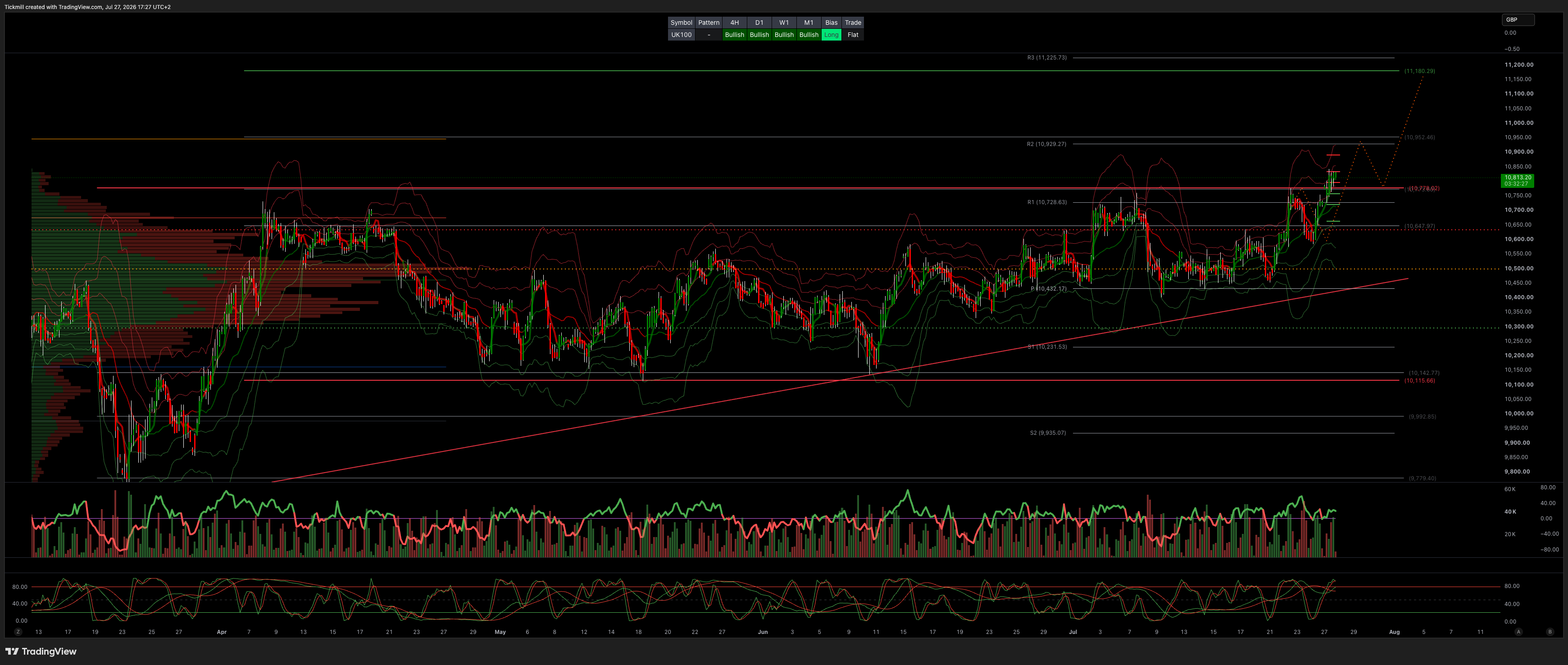
FTSE Finish Line: July 27 — FTSE Hits Near Five-Month High as Oil Slumps and Risk Appetite Returns
London started the week on a strong note, with the FTSE 100 climbing to a near five-month high on Monday as easing Middle East tensions lifted risk appetite and tumbling oil prices triggered a rotation away from energy and into consumer, travel, telecoms and growth-sensitive names. The shift in sentiment followed a pause in military strikes between the U.S. and Iran over the weekend. After the U.S. held off from fresh strikes for a second night, Iran also stopped conducting counterattacks, easing immediate fears of a return to full-scale war. Reports that Pakistan is exploring a pathway toward renewed U.S.-Iran talks further encouraged investors to position for a de-escalation scenario.
Oil was the clearest market expression of that relief. Brent crude futures slid to $84.91 a barrel, losing more than 8%, as traders unwound part of the geopolitical risk premium that had built during the conflict. The drop in oil helped ease concerns about inflation, household energy bills, transport costs and corporate margins. For the broader UK equity market, that was supportive, even though it weighed heavily on the FTSE’s large energy names.The result was a powerful sector rotation. Energy stocks fell sharply, with BP tumbling 3.4% and Shell dropping 1.7%, as lower crude prices hit earnings expectations. In previous sessions, energy had helped cushion the FTSE against geopolitical risk. On Monday, the same sector became a drag, but the broader index still advanced because investors saw lower oil as a net positive for the economy, consumers and inflation expectations.
The rally was led by stocks that benefit from lower fuel costs, improved consumer sentiment or a less threatening rate backdrop. Vodafone jumped 4.5% after the telecoms major said it expects full-year earnings to come in at the upper end of guidance. That update gave the market a clear company-specific catalyst and helped telecoms participate strongly in the broader risk-on move.
JD Sports Fashion climbed 4.3%, reflecting renewed appetite for consumer discretionary exposure as lower oil prices eased concerns about real-income pressure. If fuel and energy costs fall, households may have more room for non-essential spending, though the improvement still has to be measured against weak consumer confidence and elevated living costs.
RELX rose 3.8% and Airtel Africa gained 3.7%, while Sage, Pershing Square Holdings, Auto Trader, IAG, St. James’s Place, Investec, BT, Burberry, Barclays, Whitbread and Entain advanced between 2% and 3%. The breadth of the gains was important. Monday’s market was not simply a defensive rebound; it reflected investors moving back into travel, leisure, financials, consumer names, telecoms and software-linked shares.
IAG’s gain was particularly consistent with the oil move. Airlines are highly sensitive to fuel prices, and the sharp decline in Brent immediately improved the margin narrative for carriers, even if geopolitical uncertainty has not disappeared. Whitbread and Entain also benefited from the improved consumer and leisure tone, while Burberry recovered as risk appetite improved and investors reassessed the potential for tourist spending disruption to ease if the Middle East conflict cools.
Banks and financials also participated. Barclays, Investec, St. James’s Place and Pershing Square all rose as investors leaned into a more constructive macro scenario. Lower oil reduces the risk of another inflation spike, which in turn eases pressure on central banks. For financials, the ideal backdrop remains one where growth holds up, inflation softens and rate expectations do not collapse too quickly. Monday’s move suggested the market was shifting closer to that scenario.
AstraZeneca climbed more than 1.5% after reporting second-quarter profit ahead of expectations and backing both its annual and long-term forecasts. The update helped restore confidence in one of the FTSE’s largest healthcare names after recent trial-related disappointments in the sector. GSK also moved higher, while other large-cap gainers included Land Securities, Experian, Rolls-Royce, LSEG, Marks & Spencer, Lion Finance, Computacenter and InterContinental Hotels Group.
The strength in Land Securities and other rate-sensitive names reflected the lower-inflation implication of falling oil. If energy prices continue to decline, pressure on headline CPI should ease, giving the Bank of England more room to maintain its active-hold stance and eventually pivot more dovishly if domestic inflation continues to moderate. That is supportive for property, housebuilders and other duration-sensitive equities.
Still, not all commodity names benefited. Glencore fell 2.25%, while Centrica, SSE, Rentokil Initial and Imperial Brands also weakened. The decline in Glencore reflected the broader pressure on resource-linked names as the market moved away from war-premium trades. Centrica and SSE were softer as lower energy prices and shifting rate expectations weighed on utilities and energy-linked defensive exposures.
The domestic data were cautiously encouraging. The Confederation of British Industry said its retail sales balance improved to -26 in July from -54 in June, much better than market expectations for -45 and the smallest decline in UK retail sales in six months. The report added to the recent evidence that the UK consumer is not deteriorating as quickly as feared. However, the CBI also warned that the sector continues to face headwinds from weak consumer confidence and elevated cost pressures, leaving the outlook subdued. That caveat matters. Monday’s rally showed relief, not a full reset. Lower oil helps, but households are still navigating high bills, borrowing costs and uncertainty. Retailers may be seeing a less severe downturn, but the sector is not yet signalling a strong recovery.
For Prime Minister Andy Burnham, the oil slump is helpful. His early policy push has focused on lowering household energy bills, supporting businesses and easing cost-of-living pressure. A sharp fall in crude reduces near-term pressure and gives the government more breathing room. But markets will still judge the administration on fiscal credibility, especially after a rapid series of policy announcements in its first week. For the Bank of England, Monday’s move also helps. June CPI eased to 2.6%, marking a third consecutive downside surprise relative to the MPC’s expected path, while wage growth has moderated and unemployment has held steady. If oil remains closer to $85 than $90-plus, the near-term inflation threat becomes less acute. That supports a hold at 3.75%, with policymakers able to wait for confirmation that services inflation and wage pressure are also moving in the right direction.
Finish Line: The FTSE 100 climbed to a near five-month high as the U.S. and Iran paused strikes, Pakistan explored a route back to talks, and Brent crude slid more than 8% to $84.91. Lower oil hammered energy stocks, with BP down 3.4% and Shell off 1.7%, but it lifted the broader market by easing inflation, fuel-cost and consumer-pressure concerns. Vodafone surged after guiding earnings to the upper end of expectations, while JD Sports, RELX, Airtel Africa, IAG, Burberry, Barclays, Whitbread and Entain gained on the risk-on rotation. AstraZeneca rose after beating profit expectations and backing forecasts. The CBI retail sales balance improved sharply, though weak confidence and cost pressures still cloud the outlook. Monday’s rally was a de-escalation trade: less war premium in oil, more appetite for consumers and cyclicals, and a little more breathing room for both the BoE and the Burnham government.
TECHNICAL & TRADE VIEW – FTSE100
Daily VWAP Bullish
Weekly VWAP Bullish
Above 10500 Target 11000
Below 10400 Target 9500
Disclaimer: The material provided is for information purposes only and should not be considered as investment advice. The views, information, or opinions expressed in the text belong solely to the author, and not to the author’s employer, organization, committee or other group or individual or company.
Past performance is not indicative of future results.
High Risk Warning: CFDs are complex instruments and come with a high risk of losing money rapidly due to leverage. 68% and 74% of retail investor accounts lose money when trading CFDs with Tickmill UK Ltd and Tickmill Europe Ltd respectively. You should consider whether you understand how CFDs work and whether you can afford to take the high risk of losing your money.
Futures and Options: Trading futures and options on margin carries a high degree of risk and may result in losses exceeding your initial investment. These products are not suitable for all investors. Ensure you fully understand the risks and take appropriate care to manage your risk.
Patrick has been involved in the financial markets for well over a decade as a self-educated professional trader and money manager. Flitting between the roles of market commentator, analyst and mentor, Patrick has improved the technical skills and psychological stance of literally hundreds of traders – coaching them to become savvy market operators!